
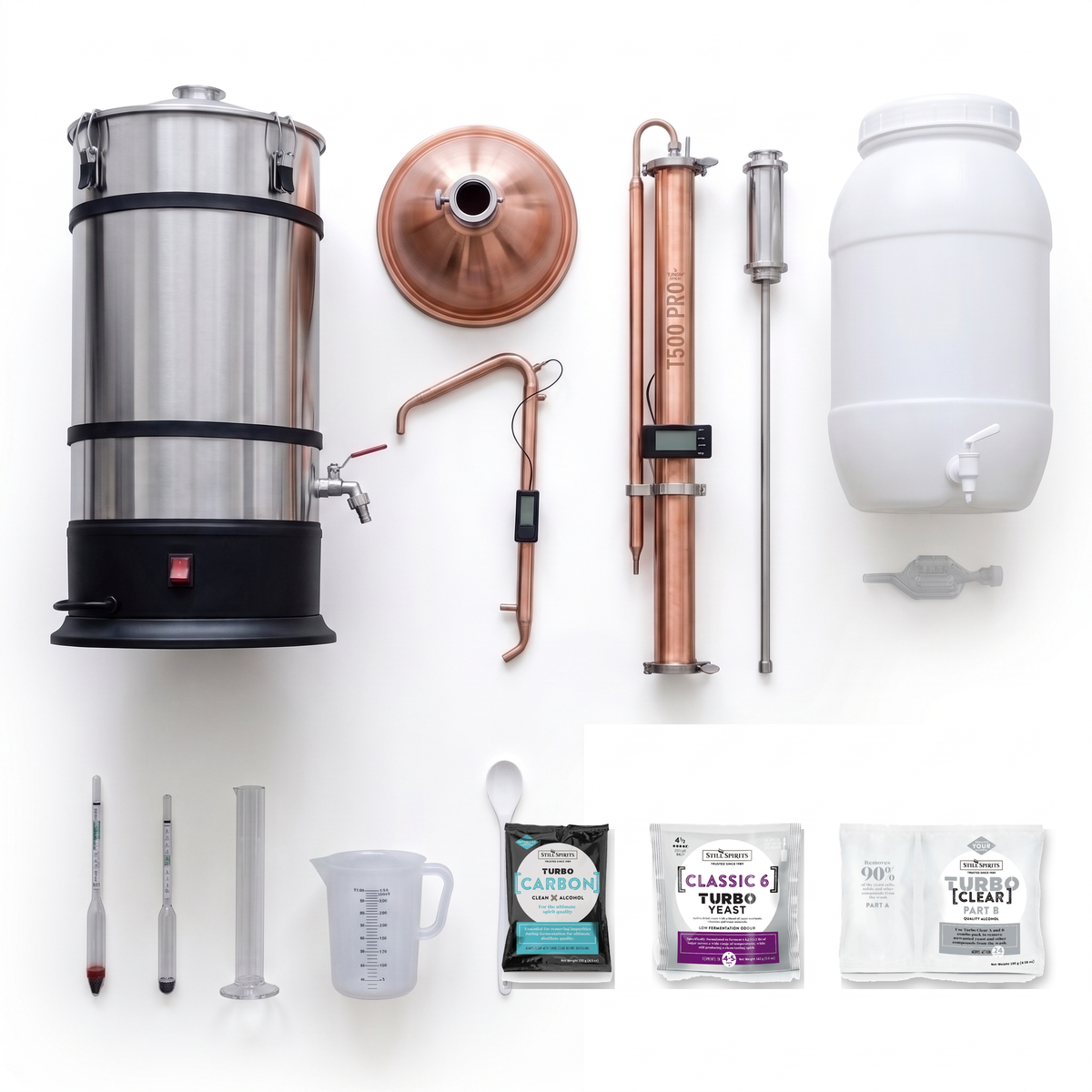
A reflux still strips your spirit back to clean neutral alcohol. A pot still carries the flavour of the wash straight through into the glass.
That is the whole difference, and it is not a quality question. Neither design is better than the other. Every still sold in Australia is one or the other, or a unit that switches between them. They do two different jobs, and the one you want depends entirely on what you plan to make first.
What a reflux still does
A reflux still puts a packed column between the boiler and the collection point. Vapour rises into that column, cools, falls back, and rises again. Every one of those passes leaves more of the heavier compounds behind.
What comes out the other end is close to pure alcohol. The Turbo 500 reaches up to 93% ABV and recovers up to 95% of the alcohol present in the wash.
Neutral spirit at that strength has almost no character of its own. That sounds like a loss until you realise it is the point. A neutral base is a blank canvas, and it is what every essence and every botanical infusion is designed to be added to. If vodka is your target, or you want to work with Top Shelf essences, reflux is the design that gets you there.
A run on the Turbo 500 range takes four to five hours and cools on ordinary tap water, so there is no chiller to buy or plumb in.
What a pot still does
A pot still does the opposite, and it does it by leaving things out. There is no packed column and no second condenser. Vapour boils off, hits the condenser once, and gets collected.
Everything the wash carried comes through with it. That is exactly what you want for whisky from a malt wash, rum from molasses, or brandy from fermented grapes. The character of the base ingredient is the product.
It also means the wash you start with sets the ceiling on what you finish with. A rough wash gives you a rough spirit, and no amount of care later in the run will take that back out. This is the part beginners tend to find out the hard way.
The alembic pot stills in the Still Spirits range are the traditional shape for this, and the copper is not decoration. Copper reacts with sulphur compounds during the run, which is why it has stayed the material of choice for flavoured spirits.
If you are new to the mechanics of any of this, how a still works covers the boiler, the condenser and the temperatures underneath both designs.
Which one suits what you want to make
Start from the spirit, not from the still. Once you know what is going in the glass, the choice makes itself.
| What you want to make | Design | Why |
|---|---|---|
| Vodka | Reflux | Neutral is the product. Strip everything out |
| Spirits from essences | Reflux | The essence supplies the character, so the base should have none |
| Gin | Pot, with a botanical basket | The botanicals need to be carried through, not stripped out |
| Whisky | Pot | The malt character is the whole point |
| Rum | Pot | Molasses character carries through |
| Brandy | Pot | The fruit character carries through |
| Schnapps and liqueurs from a mix | Reflux | Clean base, flavour added afterwards |
Read down that table and a pattern shows up. If the flavour is coming from the wash, you want a pot still. If the flavour is coming from something you add later, you want reflux.
The unit that runs both ways
Most people find they want both eventually, and there is one unit in the range that does not make you choose.
The Air Still Pro is a benchtop still that switches between the two modes by changing the distillation tip. In reflux mode it produces neutral spirit at up to 90% ABV. In pot still mode it reaches up to 80% ABV and, with the included botanical basket, that means gin.
It holds a four litre wash and yields roughly 1.1 litres at 40% ABV per run. It cools itself with a built in fan, so there is no plumbing and no water supply to organise, and the first 30ml of every run is collected automatically in a foreshots vial.
That last detail matters more than it sounds. Separating the foreshots is the step most likely to go wrong by hand, and on this unit it happens whether you remember or not.
Four litres is a small batch. If you already know you want volume, the column systems are the other end of the range.
What the choice does not change
Both designs sit downstream of the same thing, and it is not the still.
The biggest variable in your result is fermentation quality, not the still. Use the included Turbo Production Pack, keep your wash temperature stable, and let it clear fully before you distil. A cloudy wash in means a cloudy result out.
Hamish, Australian Home Brewing
Reflux is more forgiving of a rough wash than pot, because it strips more out. Forgiving is not the same as immune. Get the ferment right and either design will do its job.
Where the law sits
In Australia you need a licence from the ATO to distil spirits, including at home. Owning a still and buying one are both entirely legal. Those are two separate things and it is worth being clear about which is which.
Stills also have uses that need no licence at all, including distilling water and extracting botanical oils and hydrosols.
The complete guide to home distilling in Australia covers the licensing position properly, along with the rest of the legal ground.
Common questions
Which reflux still suits a first time distiller?
It depends on space more than skill. The Air Still Pro is a benchtop unit that needs no plumbing, which makes it the practical answer in a flat or a small kitchen. The Turbo 500 handles a 25 litre wash and needs a tap, so it suits a shed or a laundry.
Do you need to do a stripping run with a reflux still?
Not usually. A reflux column does in one pass what a stripping run plus a spirit run does on a pot still, which is the main reason the design exists.
At what ABV do you stop collecting?
Watch the strength coming off rather than the clock. Collection strength falls steadily as the run proceeds, because the alcohol left in the boiler keeps dropping and the water content of the vapour keeps rising. The tail end of a run is weak and carries the compounds you were separating out in the first place.
Do I need to clear my wash before distilling?
Yes, and it is the single step most worth your patience. Solids carried into the boiler scorch against the element and the result carries that through. Let it clear fully.
Can one still do both jobs?
Yes. The Air Still Pro switches between reflux and pot modes, so you are not committed to one path when you buy.
Where to go next
If you have picked a lane, the range pages are the next stop. If you want the two put side by side on price and capacity, choosing a home distilling kit in Australia does that comparison properly.
And if you are still not sure, the shop is open Saturdays 9am to 1pm and the phone is answered the rest of the week. Australian Home Brewing has been doing this since 1968, and this is a much shorter conversation in person than it is on a page.
Written by Hamish Rodgers-Wilson, Australian Home Brewing. Australian Home Brewing has supplied home brewers and distillers since 1968.


Leave a comment
This site is protected by hCaptcha and the hCaptcha Privacy Policy and Terms of Service apply.