
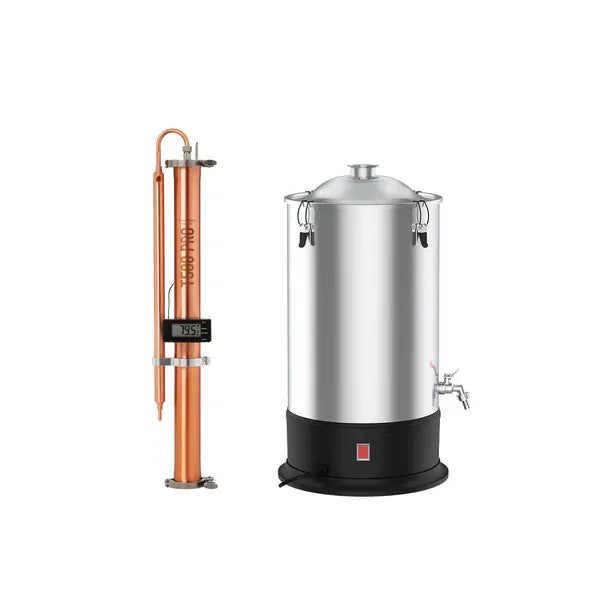
The short answer: a still is a device that separates liquids by their boiling points. It heats a fermented wash so the alcohol, which boils at about 78°C, turns to vapour before most of the water, which boils at 100°C. A condenser then cools that vapour back into liquid. Every still has two main parts, a boiler and a condenser, and there are two main types: pot stills and reflux stills.
How distillation works
A still (short for distillation unit) separates a mixture of two or more liquids into their individual parts. The same principle separates oil from water, or petrol from crude oil. In home distilling, it separates alcohol from a fermented wash of alcohol and water.
Distillation works because the liquids boil at different temperatures. Water boils at 100°C and ethanol, the alcohol we drink, boils at about 78°C. When a mixture of water and ethanol is heated, it starts to boil at around 80°C, and the vapour rising is mostly ethanol. In a still, that vapour is cooled so it turns back into liquid and is collected outside the still, while most of the water stays behind in the boiler.
The parts of a still and how they work
Every still has two basic components: a boiler to make the vapour, and a condenser to cool the vapour and collect the liquid. Condensers are cooled either by cold water running through a jacket or tubes, or by a fan blowing air across cooling coils.
The boiler heats the liquid mixture, called the "wash", to produce vapour. That vapour carries a mix of alcohol, some water and some by-products from fermentation. The balance changes as the run goes on: early on, the vapour is mostly alcohol with a little water, and later the water content rises. That means the spirit collected early is stronger than the spirit collected at the end.
The condenser cools the vapour back into liquid, which drips out to be collected. The boiler and condenser need to be balanced, so the rate of boiling matches how much the condenser can cool. The temperature of the wash also rises during the run. With plenty of alcohol in the wash, it boils just below 80°C. As the alcohol is removed, the boiling temperature climbs, until the last of the alcohol comes off at about 93°C. At that point the boiler holds mostly water and the run is finished.
Pot stills and reflux stills
There are two basic types of still, and the difference is in the condenser.
Pot still. All the vapour from the boiler is collected and condensed back to liquid. The result is a lower-strength spirit that carries more flavour from the wash, which suits spirits like whisky and rum.
Reflux still. A reflux still has a column before the main condenser. Cooling in the column makes heavier vapours, including water and impurities, condense and drip back into the boiler. The vapour that makes it through is mostly alcohol, so the spirit is stronger and cleaner, with fewer by-products. That makes it the better choice for a neutral base for vodka, gin and liqueurs.
For a deeper comparison, read reflux still vs pot still: how to choose.
The stills we sell
- Air Still and Air Still Pro. Benchtop stills cooled by a fan, so there is no plumbing. They take 4 litres of wash and give about 1 litre of spirit at drinking strength. The Air Still Pro adds a switch between pot and reflux modes.
- Turbo 500. A larger still with a bigger boiler and interchangeable condensers, for bigger batches.
- Alembic pot stills. Traditional copper pot stills for flavour-led spirits.
New to distilling? Start with our complete guide to home distilling in Australia, or see a still in action in how to make vodka at home.
Frequently asked questions
What is a still?
A still is a device that separates liquids by their boiling points. In home distilling, it heats a fermented wash so the alcohol turns to vapour first, then cools that vapour back into a stronger liquid in the condenser.
What is the difference between a pot still and a reflux still?
A pot still condenses all the vapour, giving a lower-strength spirit with more flavour carried over from the wash. A reflux still sends heavier vapours and water back to the boiler, giving a stronger, cleaner and more neutral spirit, which suits vodka and gin.
Which still is best for beginners?
For most beginners, a benchtop Air Still or Air Still Pro. It runs off a power point, needs no plumbing and takes 4 litres of wash at a time, so it fits in a kitchen.
Is it legal to own a still in Australia?
Yes. A still of 5 litres or under needs no permission at all. Larger stills need a permit from the ATO, which covers buying, owning and moving one. Distilling spirits to drink needs an ATO excise licence, which is set up for commercial distilleries rather than home use.


Leave a comment
This site is protected by hCaptcha and the hCaptcha Privacy Policy and Terms of Service apply.