

50+ Years in the industry
Brewing beer spirits before man landed on the moon.

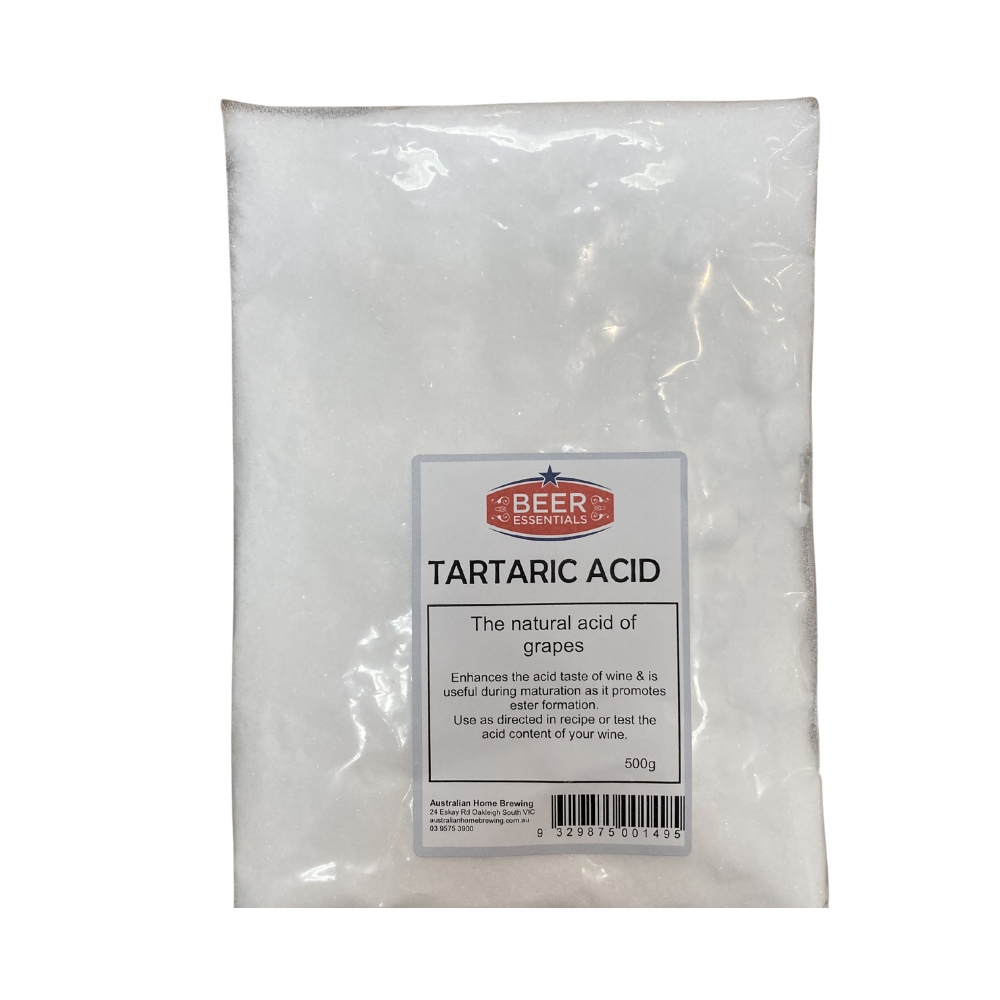

Tartaric acid is the main acid found in grapes, and the standard choice for adjusting the acidity and pH of homemade wine. This is a food grade powder, available in 25g, 100g and 500g packs.
Most orders dispatched within 1-2 business day from Melbourne. shipping calculated at checkout. View shipping information
Tartaric acid is the main acid found in grapes, and the standard choice for adjusting the acidity and pH of homemade wine. This is a food grade powder, available in 25g, 100g and 500g packs. If a wine tastes flat or your pH is reading too high, this is what brings it back into balance.
Best suited to
Technical specs
Which size do I need?
When to choose this over malic or citric acid
For grape wine, reach for tartaric first. It is the acid grapes already contain, it is stable, it does not get eaten by bacteria during fermentation, and it gives wine its proper vinous bite. When you are not sure which acid a grape wine needs, tartaric is the safe answer.
Choose malic acid instead when you are making cider, or a fruit wine that you want to taste crisp and green-apple fresh. Just don't add malic to anything going through malolactic fermentation, because the bacteria will convert it to lactic acid and undo the work.
Leave citric acid for after fermentation is fully finished. It brings a sharp lemony note, but if bacteria get at it they can throw off buttery and vinegary off-flavours. Tartaric has none of that risk.
Practical notes
How much to add: Roughly 1g per litre will drop pH by about 0.1. So to take a 20L batch from pH 3.6 down to 3.4, you are looking at around 40g. Always measure with a meter or test kit rather than guessing, and adjust in small steps.
How to add it: Dissolve the powder in a small amount of warm wine or water first, then stir that solution through the batch. Adding it before fermentation lets it integrate properly.
A note on cold weather: If you cold stabilise or store wine through a Melbourne winter, some added tartaric will drop out as crystals (tartrate) and your acidity will ease back a touch. Account for that if you are adding right up to your target.
Storage: Keep it dry and sealed. Tartaric acid is happy on the shelf for years as long as moisture stays out.
Australian Home Brewing, est. 1968.
Buying from us
Questions about this product, shipping and orders. See the FAQ page for more topics.
As a rule of thumb, about 1g per litre lowers pH by roughly 0.1. For a 20L batch that is around 20g per 0.1 of adjustment. Dissolve it first, add it before fermentation, and always check with a pH meter or acid test kit rather than adding by eye.
Yes. This is food grade tartaric acid, additive code E334, the same acid naturally present in grapes. It is approved for food and beverage use in Australia and New Zealand.
Tartaric for grape wine, every time. It is stable, it is what grapes naturally contain, and it will not be broken down by bacteria. Save citric acid for after fermentation has finished, and even then use it sparingly because it can add an aggressive lemon note.
Yes, it is food grade. It is the classic acid in homemade lemonade cordial and is used in some baking and confectionery. For winemaking it is the headline use, but the same pack does the job in the kitchen.
Latest from Australian Home Brewing
How-tos, product notes, and distilling guides from the people who actually brew.
50+ Years in the industry