

50+ Years in the industry
Brewing beer spirits before man landed on the moon.

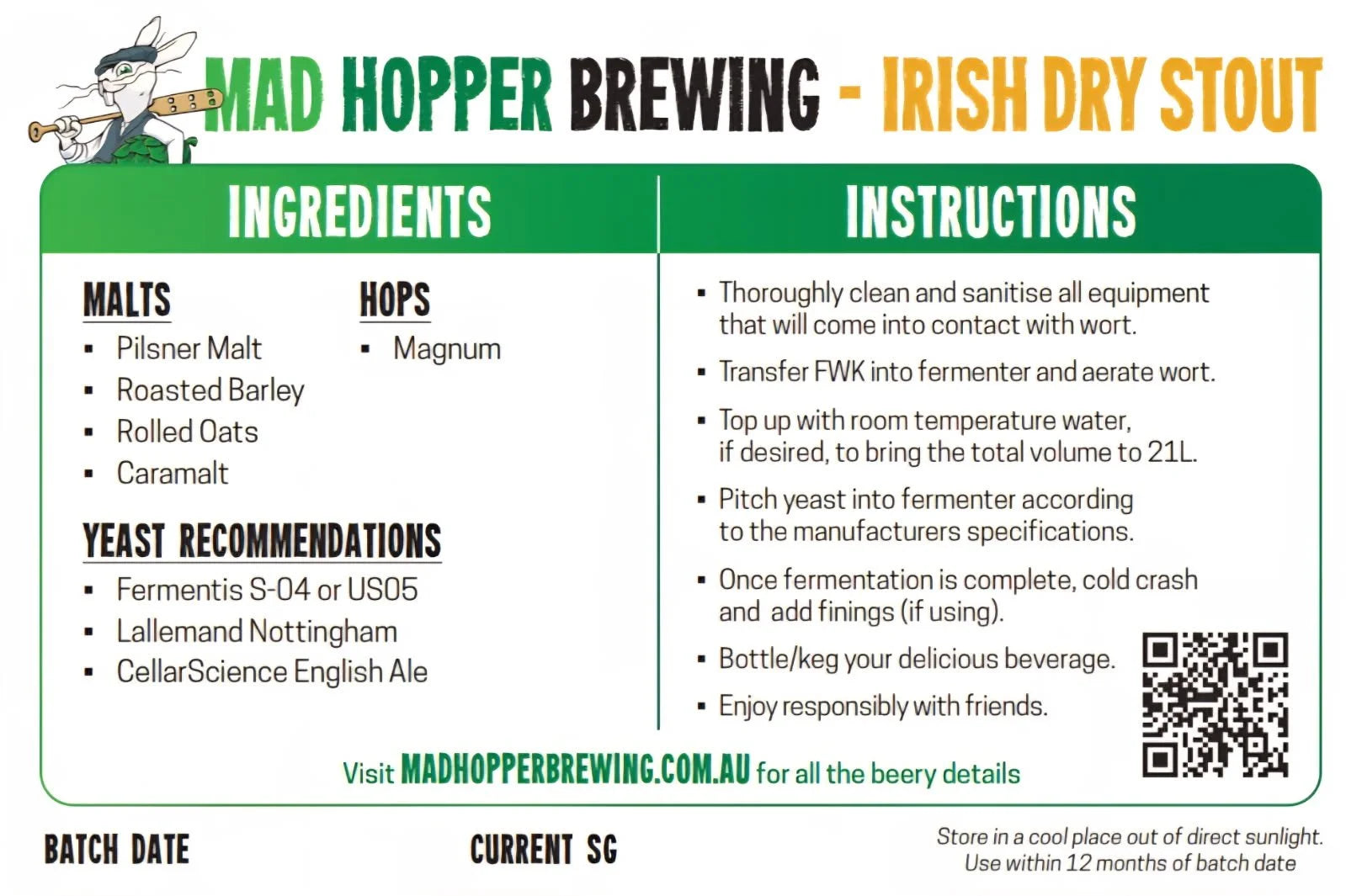
Pub-quality Irish dry stout without the brew day. Mad Hopper has done the mashing, hopping and boiling; you do the fermentation. This 17-litre fresh wort kit ferments out to 21 litres of smooth, roasty, silky stout.


Normally shipped from our Melbourne warehouse within 2 business days (longer in peak periods). Shipping calculated at checkout by weight and postcode.
Dispatch. Orders normally ship from our Melbourne warehouse within 2 business days, longer during peak periods, fully tracked by Australia Post or one of our couriers. We email the tracking the moment it leaves.
Cost. Shipping is calculated at checkout from the parcel weight and your postcode, so you see the exact figure before you pay.
Changed your mind? Return it within 30 days of delivery, unused and in its original packaging, for an exchange or refund. Contact us first so we can arrange it. Original delivery and return postage are not refunded.
Arrived damaged or missing parts? Tell us as soon as it lands and we will replace or fix it and cover your return postage.
Warranty. Every product carries its manufacturer warranty, backed by Australian Consumer Law. Full refund policy
Brewery-made Irish dry stout wort from Mad Hopper, ready for you to ferment. The mashing, the hopping and the boiling are done. You pitch the yeast, hold the temperature and finish it. Seventeen litres of wort in the bag, tops up to 21 litres in the fermenter.
The beer
A smooth, malt-forward dry stout in the classic Irish style. Roasted barley brings the colour and the dry, coffee-edged finish, rolled wheat gives it a silky body and a head that holds, and a touch of caramalt rounds it out. Magnum hops sit underneath for balance without getting in the way of the roast. Espresso, dark chocolate and a faint hint of vanilla on the palate. Not heavy, not sweet, built for a full pint.
| Style | Irish Dry Stout |
| Wort volume | 17 litres |
| Final volume | Top up to 21 litres (optional) |
| Target OG | 1.056 |
| Malts | Pilsner malt, roasted barley, rolled wheat, caramalt |
| Hops | Magnum |
| Yeast | Not included. Fermentis S-04 or US-05, Lallemand Nottingham, or CellarScience English Ale |
| Fermentation temp | 18 to 20 degrees C with an English ale yeast |
| Shelf life | 12 months from the batch date on the label, stored cool and dark |
| Skill level | All levels |
What's in the box
Yeast is not included. Grab a sachet of S-04 for a rounder, more English character, or US-05 if you want the roast to do all the talking.
When you know you have nailed it
Appearance: Black with ruby edges when you hold it to the light. A dense, creamy tan head.
Aroma: Roasted grain, fresh coffee, a little dark chocolate. No hop aroma to speak of, and there should not be.
Flavour: Roast up front, a soft malt middle, then a dry, clean finish that asks for the next mouthful. The bitterness reads as roast rather than hops.
Mouthfeel: Silky and medium-light. Wheat in the grist keeps it smooth. Carbonate on the lower side, around 1.8 to 2.0 volumes, for the proper pub pour.
Make it your own
Fermentation guide
Hamish's verdict
Stout is the most forgiving fresh wort kit you can ferment. The roast hides small temperature wobbles that would show in a lager. If it is your first FWK, start here. And resist the urge to over-carbonate it. A dry stout at 1.8 volumes is a different beer from one at 2.6.
Reviewed by the AHB Brewing Team, September 2026.
Buying from us
Questions about this product, shipping and orders. See the FAQ page for more topics.
A fresh wort kit is actual brewery wort, mashed, hopped and boiled by professionals, that you ferment at home. The technical brewing work is done. You pitch the yeast, manage the fermentation temperature and produce a finished beer. It is not the same as a malt extract kit, where the wort is reduced to a concentrated liquid malt. Fresh wort produces a clean, fresh brew character.
A fermenter (at least 25L), an airlock, sanitiser, and bottles or a keg. If you have those, you are ready to brew.
Fermentis S-04 for a rounder, English-style stout, or US-05 if you want a cleaner ferment that lets the roasted barley do the talking. Lallemand Nottingham and CellarScience English Ale both work well too. One 11g sachet is enough for 21 litres. Yeast is not included in the kit.
21 litres if you top up, which is about 60 stubbies or one 19L keg with a couple of litres spare. Ferment the 17 litres straight, without topping up, for a bigger, richer stout and about 48 stubbies.
About three weeks. Allow 7 to 10 days for fermentation at 18 to 20 degrees, then two weeks conditioning in the bottle or keg. Stout keeps improving for a couple of months, so this is one you can cellar.
Yes. The wort is made from malted barley, roasted barley and wheat. Not suitable for coeliacs or anyone with a wheat intolerance.
50+ Years in the industry