
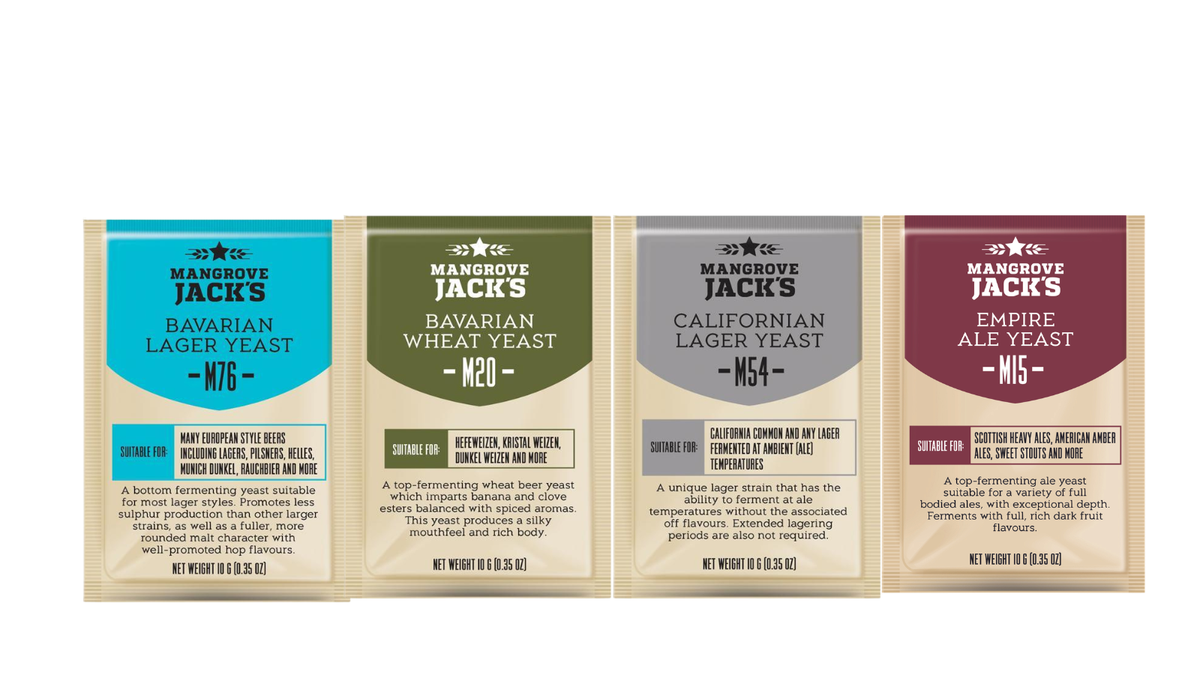
Yeast is the most underrated ingredient in home brewing. The same grain bill and hop schedule will produce a completely different beer depending on which yeast you pitch. Yeast determines fermentation character, attenuation, flavour compounds, aroma, and how clean or complex the finished beer tastes.
This guide from us covers the most commonly available yeast strains for Australian home brewers, what styles they suit, and how to get the best from them in our very unique climate.
Key Takeaways
- Ale yeasts ferment at room temperature and suit most Australian home brewers without temperature control equipment
- Lager yeasts ferment cooler (9–15°C), which makes the cooler months a natural time to brew a lager
- US-05 is the most versatile dry ale yeast and a reliable starting point for pale ales and IPAs
- Kveik yeasts ferment at high temperatures (25–42°C) and are ideal for Australian summer brewing
- Dry yeast has a longer shelf life and is more forgiving than liquid yeast for most home brewing applications
How yeast affects your beer
Yeast does three things during fermentation: it consumes fermentable sugars , produces alcohol and CO2, it generates flavour and aroma compounds as byproducts, and it determines how much sugar it leaves behind (attenuation).
Attenuation is the percentage of fermentable sugar the yeast consumes. A highly attenuative yeast produces a drier beer; a less attenuative yeast leaves more residual sweetness and body. A hefeweizen yeast at 86% attenuation produces a crisper result than an English ale yeast at 72% attenuation pitched into the same wort.
Fermentation temperature directly affects flavour. The same yeast strain fermented at 18°C versus 22°C will produce noticeably different esters and flavour compounds. Lower temperatures generally mean a cleaner, more neutral result. Higher temperatures push more fruity esters and complexity, which is desirable in some styles and a fault in others.
Understanding attenuation and fermentation temperature, really means you can then use any yeast intentionally rather than guessing.
Ale yeast strains
Ale yeasts are top-fermenting strains that work at room temperature. For most Australian home brewers without temperature control equipment, ale yeasts are the practical choice. The strains below cover the majority of beer styles most home brewers want to make. Browse the full range of brewing yeasts if you want to compare options.
Safale US-05, American ale
US-05 is the closest thing to a universal home brewing yeast. It ferments clean and neutral, which means it stays out of the way of your hops and malt. It is the standard choice for American pale ale, IPA, APA, and any style where you want hop character to lead without yeast-derived fruitiness getting in the way.
- Fermentation temperature: 15–24°C
- Attenuation: 73–77%
- Flavour: very clean, neutral, slight fruitiness at higher temperatures
- Best for: pale ale, IPA, APA, cream ale, amber ale
Shop Fermentis SafAle US-05 American Ale Yeast at Australian Home Brewing
Safale S-04, English ale
S-04 is a classic English ale yeast with a slightly fruity, biscuity character that suits darker and malt-forward styles. It flocculates quickly and drops clear faster than most ale yeasts, which is useful if you want to drink your beer sooner. It suits styles where a hint of yeast character is expected rather than avoided.
- Fermentation temperature: 15–24°C
- Attenuation: 73–82%
- Flavour: mild fruitiness, slight biscuit character, clean finish
- Best for: English bitter, ESB, porter, stout, brown ale
Shop Fermentis SafAle S-04 English Ale Yeast at Australian Home Brewing
Lallemand Nottingham, versatile English ale
Nottingham is a workhorse dry ale yeast with exceptional attenuation and a clean, neutral flavour profile closer to US-05 than S-04. It ferments reliably across a wide temperature range and drops clear quickly. Many home brewers use it as a lager substitute at cooler temperatures. Fermented at 10–12°C in a controlled environment, it produces a surprisingly clean result.
- Fermentation temperature: 10–22°C
- Attenuation: 80%+
- Flavour: clean and neutral with minimal ester production at lower temperatures
- Best for: pale ale, bitter, porter, stout; pseudo-lager at cold temperatures
Browse our dry ale yeasts at Australian Home Brewing
Safbrew T-58, Belgian ale
T-58 is a Belgian specialty yeast that produces the spicy phenolic and fruity ester character that defines Belgian ale styles. It is not a background yeast; it contributes significantly to flavour and aroma. If you want a clean beer, use US-05. If you want complex, yeast-forward character with pepper and fruit, T-58 is the right choice.
- Fermentation temperature: 15–24°C
- Attenuation: 70–80%
- Flavour: spicy phenolics, fruity esters, pepper, clove
- Best for: Belgian saison, Belgian pale ale, Belgian strong ale, witbier
Shop Fermentis SafAle T-58 Belgian Specialty Ale Yeast at Australian Home Brewing
Mangrove Jack's M20 Bavarian Wheat, wheat beer
M20 is Mangrove Jack's dry wheat beer strain and the stocked option for hefeweizen and other German wheat styles. It produces the banana (isoamyl acetate) and clove (4-vinyl guaiacol) esters that define the style, along with a silky mouthfeel and full body. In a wheat beer the yeast is the flavour, and the grain bill is secondary. Fermentation temperature determines the balance: cooler temperatures push clove; warmer temperatures push banana.
- Fermentation temperature: 18–30°C
- Attenuation: 70–75%
- Flavour: banana, clove and vanilla esters, silky body, classic hefeweizen character
- Best for: hefeweizen, kristal weizen, dunkel weizen, wheat ale
Shop Mangrove Jacks M20 Bavarian Wheat Yeast at Australian Home Brewing
Lager yeast strains
Lager yeasts ferment at cooler temperatures and produce the clean, crisp character that defines the style. Keep the fermenter in the 9 to 15°C range and they reward you with a smooth, clean beer. The cooler months are the natural time to brew a lager, and a fermentation fridge lets you brew one any time of year.
Mangrove Jack's M76 Bavarian Lager, standard lager
M76 is Mangrove Jack's dry Bavarian lager strain and the stocked benchmark lager yeast. It produces a clean, malt-forward lager with low sulphur and well-defined hop character when fermented cold. It is a reliable, widely used choice across German and European lager styles.
- Fermentation temperature: 8–14°C
- Attenuation: high (around 75–80%)
- Flavour: very clean, crisp, malt-forward, low sulphur, minimal esters
- Best for: pilsner, helles, Munich dunkel, Marzen, Rauchbier
Ferment at 10–12°C for the cleanest result. Lager conditioning after primary fermentation, holding the beer cold for 2–4 weeks, further improves clarity and smoothness.
Shop Mangrove Jacks M76 Bavarian Lager Yeast at Australian Home Brewing
Specialty and modern yeasts
Mangrove Jack's M12 Kveik, high-temperature Norwegian ale
Kveik is a traditional Norwegian farmhouse yeast that ferments at temperatures most yeasts would consider hostile. M12 produces clean beer with subtle citrus notes at fermentation temperatures up to 40°C, making it exceptionally well-suited to Australian summer brewing when ambient temperatures make temperature control difficult.
- Fermentation temperature: 20–40°C (optimal around 30–40°C)
- Attenuation: 77–82%
- Flavour: neutral with subtle citrus fruit notes; very high flocculation drops it clear fast
- Best for: Norwegian farmhouse ale, pale ale, IPA, any style where summer heat is a challenge
M12 ferments fast. Most batches complete primary fermentation in 48–72 hours at the top of its range. This makes it practical for brewers who want fast turnaround or who are brewing outdoors in warm conditions.
Shop Mangrove Jacks M12 Kveik Yeast at Australian Home Brewing
Dry yeast vs liquid yeast
Most home brewers use dry yeast. It has a shelf life of 2–3 years when refrigerated, does not require a starter for most batch sizes, is consistently available, and covers the majority of common beer styles. For most Australian home brewers, dry yeast is the right choice.
Liquid yeast offers access to a much wider range of strains with more specific flavour profiles. If you are chasing a very specific character, such as a particular Belgian strain, a house ale profile from a specific brewery, or a strain that does not exist in dry form, liquid yeast gives you options dry yeast cannot. The tradeoff is that liquid yeast has a shorter shelf life (typically 4–6 months from production), often requires a starter to build cell count, and is more sensitive to temperature during shipping.
Start with dry yeast. Once you have a clear sense of what character you are chasing in a specific style, investigate whether a liquid strain gets you closer.
Yeast and Australian conditions
Australian home brewers face a specific challenge: summer ambient temperatures are too warm for most ale yeasts to ferment cleanly. A fermenter sitting in a 30–35 degree C garage in January will produce fusel alcohols and harsh off-flavours regardless of which strain you pitch.
The practical solutions for Australian brewers:
- Brew seasonally: lagers and delicate ales in winter, robust ales and stouts in autumn and spring
- Use Kveik in summer: it is designed for high temperatures and produces clean beer where other yeasts fail
- Invest in a fermentation fridge: a second-hand bar fridge with a temperature controller gives you year-round temperature control for under $100
- Choose heat-tolerant ale yeasts: US-05 and Nottingham both handle up to 24°C better than most strains
Temperature control is the single biggest improvement most Australian home brewers can make to beer quality. A fermentation fridge lets you brew lager all year round, improves ale consistency, and removes the guesswork from summer batches. Shop our dual temperature controller.
Frequently asked questions
Which yeast should I use for my first homebrew?
Safale US-05 or Lallemand Nottingham are the best starting points for most beginners. Both are dry yeasts, both are tolerant of minor temperature fluctuations, and both produce clean, reliable results across a wide range of ale styles. If you are making a kit beer, use the yeast included in the kit for your first batch; it has been selected to work with that recipe.
How much yeast do I need for a 23-litre batch?
One 11g sachet of dry yeast is sufficient for a standard 23-litre batch at normal gravity (below 1.060 OG). Higher gravity beers such as strong ales, barleywines and Belgian triples benefit from two sachets or a yeast starter to ensure adequate cell count for a complete, healthy fermentation.
Can I reuse yeast from a previous batch?
Yes. Collecting yeast from the bottom of your fermenter after racking and storing it in a sealed jar in the fridge is standard practice. Most strains remain viable for 4–6 weeks when stored this way. Rinse the yeast with cold boiled water to remove hop debris and trub before storing. Repitch within a month for best results.
What causes off-flavours from yeast?
The most common yeast-derived off-flavours in home brewing are: fusel alcohols from fermenting too warm, giving a hot or solvent-like taste; acetaldehyde (green apple) from pulling the beer off yeast too early before fermentation is complete; and diacetyl (butter) from cold-crashing before the yeast has had time to reabsorb it. All three are avoidable with correct fermentation temperature management and patience.
You might also find these useful
- Home Brewing Guide for Beginners: the full process from equipment to bottling
- Brew in a Bag (BIAB): The Complete Guide: stepping up to all-grain brewing
- Shop all brewing yeasts: the full range: ale, lager, wheat, Belgian and Kveik

Leave a comment
This site is protected by hCaptcha and the hCaptcha Privacy Policy and Terms of Service apply.